No we haven’t lost the plot entirely. And no, we don’t mean not eating anything ever. We mean the hottest area of healthy ageing research: intermittent fasting.
Intermittent fasting has been in the news a lot in recent years: the runaway success of Michael Moseley and Mimi Spencer’s 5:2 Diet (eat normally for five days, fast for two) put it front and centre. But the weight-loss element of the Diet was originally just a welcome by-product of Dr Moseley’s research into longevity.
Dr Moseley’s original findings indicated that when the body isn’t busy digesting food, it can get on with the job of spring cleaning our bodies, a process known as autophagy. There are other benefits too: intermittent fasting has been found to lower levels of ‘bad’ cholesterol. Blood sugar levels also decrease –as do insulin levels. This means that insulin is standing by ready to spring into action next time we do eat, rather than constantly coursing through our system, which can make us insulin resistant – a pre-cursor to diabetes. High levels of insulin in the body for long periods of time promotes inflammation and fat storage in the body.
One of the doctors, Moseley interviewed in his research, Dr Valter Longo, has recently published his own study in the journal Cell Metabolism – and a book – about his own research going one stage further: a fast-mimicking diet (FMD). This requires dieters to fast for five days a month (consuming around 800 calories a day) for three months. The diet is low in protein but high in healthy fats, which according to Longo and his team, stimulates markers linked to fasting, such as low glucose levels and high ketone levels (an alternative source of energy for the brain). So you get the longevity benefits of fasting without having to actually fast for very long, or go without food completely – genius. The diet had a huge impact on the immune system. “When you starve, the system tries to save energy, and one of the things it can do to save energy is to recycle a lot of the immune cells that are not needed, especially those that maybe damaged,” Dr Longo explained.
There is another way of intermittent fasting – and that is doing it every day. There’s The Eight-Hour Diet, also known as the 16:8 diet, with all calorie consumption packed into eight hours a day. I think that’s a bit too much – if I’d had dinner at 8pm, I’d be starving by noon the next day. But Annabel is giving it a go to see how it helps with mental clarity. We’ll report back soon.
Of specific interest to me are the results of Dr Dale Bredesen’s work with people suffering mild cognitive impairment (MCI). He’s created a set for protocols which can be individually tailored to patients with MCI. We’ve written about it here before, but didn’t focus too much on the fasting element. Dr Bredesen draws on research that shows when the brain is in a state of ketosis, rather than running on glucose, it ‘spring cleans’ itself. And this process has been shown to significantly improve cognition and memory in people with MCI. Dr Bredesen also has his patients supplement their diets with coconut oil, which helps the body produce the ketones it needs for ketosis.
What makes it so appealing is that it’s so simple. Don’t eat for 12 hours. That’s it. Although to be fair, Dr Bredesen adds another element – don’t eat three hours before bed. I’ve really been trying to stick to this – eating a little earlier than I used to – by 8pm – bed at 11pm. Rather than eating breakfast at home during the working week I take a small tub to work with me to eat at my desk. I mix up my ‘breakfast pot’ the night before and it almost always contains a mix of oats, chia seeds, cinnamon, almond milk and berries. Then I vary it by adding one or more of: banana slices, cacao powder, defrosted cherries, probiotic yoghurt and nut butter. It’s pretty much the whole Kale & Cocoa philosophy in a Tupperware! By the time I get to my desk and start eating it’s gone 9.30am so I’m well past my 12 hours. I’ve been doing this for a few months now and it’s so simple to stick to. I certainly feel a little more clear headed. This system stops me cruising round the kitchen looking for snacks in the evening, plus I’m not starving and reaching for biscuits at 11am in the office. Of course, any time of fasting should be done with medical supervision. Dehydration can be an issue and I do find I need to drink more water in the mornings.
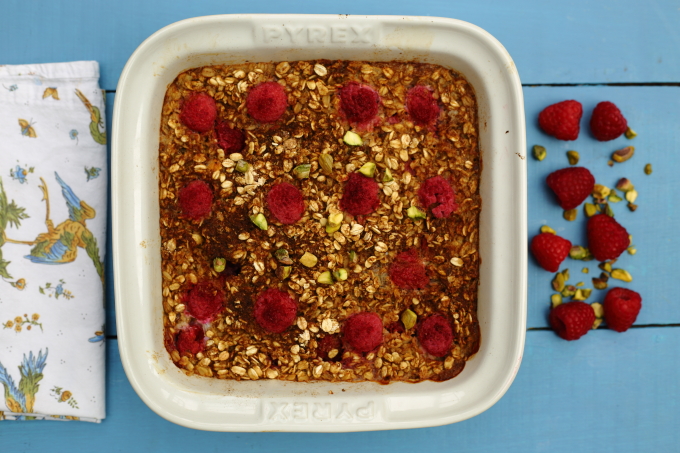
When I have more time at weekends, this baked porridge is perfect. It’s incredibly easy to make and takes around 35 minutes to bake in the oven – thus extending fasting time a bit more and creating just enough time for a work out (or reading the papers, of course!).
RECIPE: OVEN-BAKED PORRIDGE WITH BANANA AND RASPBERRIES (serves 6)
I first ate baked oatmeal when I worked in Canada and loved it. This recipe owes a debt to Heidi Swanson of www.101cookbooks.com – the Queen of baked oatmeal.
- 1 tsp coconut oil, butter or vegetable oil
- 2 bananas
- 200g rolled oats
- 2 tsp cinnamon
- 2 tbs ground flaxseed
- 1 tsp baking powder
- 100g raspberries
- 1 egg, beaten
- 500ml almond (or regular) milk
- 3 tbs maple syrup
- chopped pistachios and extra raspberries, to serve
Pre-heat the oven to 180C. Grease a baking dish with the oil or butter. Slice the bananas into thick coins and spread over the base of the dish. Sprinkle over most of the raspberries, saving a few for decoration.
Mix the oats, cinnamon, flaxseed and baking powder in a large bowl, then tip into the baking dish on top of the fruit. Mix the milk, egg and maple syrup. Pour this mixture over the oat mix so everything gets soaked. Push the remaining raspberries into the top of the dish.
Bake for around 35 minutes then leave to stand for five minutes. Serve with the pistachios sprinkled over and more raspberries. A dollop of yoghurt is good too.
Any leftovers are great for my al desko breakfast pots!
Susan
I’m not totally convinced about the benefits of fasting – my athletic daughter pointed out that no athlete’s regime includes fasting. I do eat early in the evening, so mostly get a twelve hour fast overnight, but would not feel safe biking to work on an empty stomach. I’m the light side of normal BMI. I feel faint and headachy if I don’t eat, and consume small meals five times a day. I know this is currently unfashionable, but its time will no doubt come round again :o)
If you’re eating early supper, you’re probably getting in a 12 hour fast without being aware of it, as you say. Thanks for the comment!
I will have to think about trying this… but I hate going to bed hungry. Maybe I could compromise and still have my tea (with milk of course) before bed. I loved the 5:2 diet and stuck with it for several years, but slowly it got harder to maintain for some reason, and I am struggling to get back on it (and struggling to keep of those few extra lbs – unlike Lexi I am on heavy side of normal BMI).
Thanks Nan. I don’t go to bed hungry and am dashing around in the morning so really don’t notice the 12 hour fast. I don’t think I could go much longer though!
I have found that fasting about 80% of the time between 12 and 14 hours works very well for me. I love the flexibility of this approach as it enables me to do exactly what I want and I put no pressure on myself. If I get hungry, I eat, if I am late with supper, so be it and if I am asked out I eat when served.
That’s what we do too. Far less stressful than counting the hours while ones stomach rumbles away! Thanks for the comment…