How did you sleep last night? If the straw poll of friends around my dinner table this week (all women around 50) is anything to go by, then not very well. Today is World Sleep Day: designated to encourage us to focus on getting some shut-eye. We’re living in an epidemic of sleeplessness which has a huge impact on our health as we age. And one of the major causes of this is the electric light which dominates our lives – not just from light bulbs, but televisions, phones, alarm clocks, computers and tablets.
Our bodies simply aren’t designed to deal with all this artificial light. Our delicate circadian rhythms (which make us sleep and wake) are programmed to respond to light – as in daylight. Not the round-the-clock gleam of our electronic devices. And the knock-on effect on our health is devastating: when our bodies are exposed to more light, they produce less melatonin, the vital sleep-inducing hormone which regulates our circadian rhythms. A lack of quality sleep has a profound effect as we age and has been linked to an increased risk of dementia, cardiovascular problems, diabetes and obesity.
Not all light is created equal. Basic physics: light is made up of seven colours – you know, the colours of the rainbow. Different coloured light has a different impact on our bodies. In the daytime, blue light is what we want: it boosts mood, alertness and reaction times. But that’s exactly what we don’t want at night. Those screens we are glued to in the evenings emit blue light, and keep us awake. Plus, the energy-saving LED light bulbs we are encouraged to buy emit more blue light, so it is increasingly hard to avoid in our homes.
Harvard researchers tested the effects of exposure to blue light against exposure to green light of comparable brightness. The blue light suppressed melatonin production for about twice as long as green light, and shifted circadian rhythms by three hours as opposed to one and a half hours. Red light has the least impact on melatonin production – so if you need a night light, make it a red one – research from Israel shows that looking at a red-light emitting screen between 9pm and 11pm has almost no negative impact on melatonin production.
Like my friends, I often struggle to sleep well, taking ages to nod off. Annabel and I have both experimented with using melatonin supplements and sprays, but with mixed results – and we’re not mad about taking lots of supplements. She blogged about it here. So with World Sleep Day in mind I’ve decided to take charge of my exposure to light. This is my plan:
- Minimal use of computers and phones after 9pm. I’ll try and ‘power down’ earlier in the evenings, and use the time to read, get ready for the morning and sleep.
- If I can’t avoid looking at a screen after 9pm – and sometimes I can’t – then I’ve ordered some orange tinted glasses from Amazon to block the blue light. They look hideous but I’m not going to wear them in public!
- I’ve downloaded a free application called f.lux (there are others like Twilight or Redshift) onto my laptop. These programmes can be set to reflect sunrise and sunset wherever you are in the world so that the screen emits less blue light in the evenings. It means my screen has a slight strange pinkish glow in the evenings, but it’s rather soothing.
- I’m experimenting with the night-shift settings on my iPhone (I’m sure there’s an equivalent for Android devices but I’m afraid I don’t know what it is). I’ve made the colour temperature warmer and set it to ‘manually enable until tomorrow’ so the changes stay in place over night.
- I’ll look into red or orange light bulbs for the bedroom (but they might look a bit weird in the mornings?)
- And absolutely no electronic devices in the bedroom at night!
SUSHI BOWLS – SERVES 4
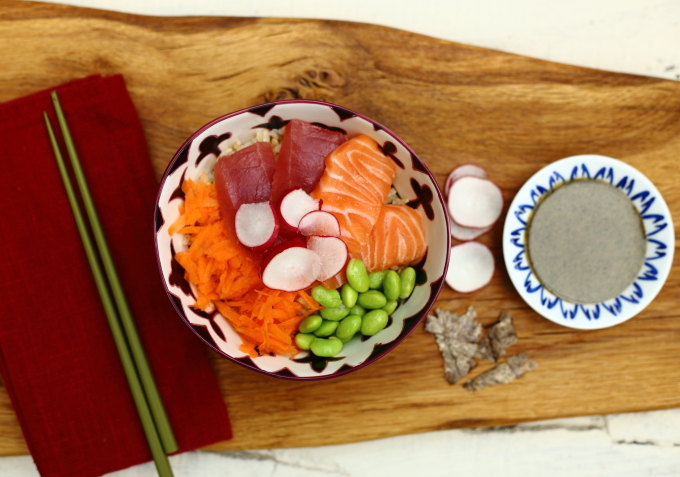
These bowls are super quick and simple to make: cook some rice, whizz up a dressing and prepare some toppings. My children love these bowls – do swap in any vegetables or fish you like. These bowls are perfect for when you get home from work and don’t want to stay up late cooking or clearing up – more time for sleeping!
- 300g brown sushi rice (or other type of short-grain rice)
- 2 tbs sushi seasoning (or use 1/2 tsp each of salt and sugar with 1 tbs vinegar)
- 4 carrots, peeled and grated
- 1 chunk of cucumber
- 1 avocado, peeled and sliced
- 100g smoked tofu
- 2 tuna or skinless salmon steaks or a pack of ready prepared sashimi (optional)
- edamame beans, cooked
DRESSING
- 3 sheets of nori
- 4 tbs soy sauce
- 100ml water
- 2 tbs sesame oil
- 2 tbs rice vinegar
Cook the rice according to the packet instructions. While it’s cooking, prep all your toppings. Slice the avocado and cucumber. Cut the tofu into cubes and finely slice the fish, if using cutting across the grain of the fish diagonally (unless you’ve splashed out on sashimi, in which case it’s ready cut for you).
Make the dressing by whizzing up all the ingredients in a blender (it won’t look very pretty, but it does taste good). Add a splash more water if needed.
Drain the rice, and stir in the seasoning. Divide between four bowls and arrange the toppings over it. Drizzle over some of the dressing and put the rest on the table in a small bowl.
Susan
Leave a Reply