As readers of this blog will know, I take no vitamin supplements. Except in December when I normally take a vitamin D supplement for a few months.
But this year I didn’t. Until yesterday, when I did. Confused? I was too. And that’s the point. We are bombarded by constantly changing and often opposing information all purporting to be from experts – medics, scientists, nutritionists. Susan’s brilliant post last week on Dry January illustrated the same quandary but in relation to alcohol.
At some point we have to weigh up the information and make the decision we feel is right for us. Of course this is easier if we have up-to-the-minute information on the state of our individual health – our vitamin, mineral and hormone levels, our microbiome, our gene pool and so forth. Sadly, most of us don’t. Yet.
But back to Vitamin D. This December I was deeply immersed in Professor Tim Spector’s The Diet Myth (thank you to the reader who recommended it, it’s fascinating). Prof Spector dislikes diets and supplements. His reasons are indeed compelling and he has years of research to support them. And broadly I’m in agreement. You can read his views on Vitamin D at https://theconversation.com/the-sun-goes-down-on-vitamin-d-why-i-changed-my-mind-about-this-celebrated-supplement-52725.
In a nutshell, Prof Spector suggests that, at best, Vitamin D has no effect and, at worst, it may upset the sensitive immune processes taking place in our gut. He argues that we can get enough Vitamin D by eating some oily fish.
As my gut is probably the most damaged part of my body, I held off reaching for the Vitamin D (after all, I do eat oily fish twice a week).
But then I attended a lecture by Professor Steve Jones on sunlight (which makes Vitamin D). Prof Jones has been studying sunlight for the last two years. His main premise is that ‘sunlight is really good for you’. His talk featured a series of slides on what happens when you don’t get enough: less sunny countries have significantly higher rates of multiple sclerosis, cancer, heart disease, suicide, depression, Type 1 diabetes, rickets (which is making a come-back in the UK after we thought it had been eradicated), and respiratory infections.
If you live in Scotland, says Prof Jones, there are eight months of every year in which you cannot make any vitamin D – there’s simply not enough sunlight. Up goes a slide showing the high rates of heart disease, cancer, depression etc in Scotland (which also has one of the lowest life expectancies in Europe).
If you live north of Birmingham (a city in the English Midlands), you can never quite synthesise enough vitamin D from sunlight, he adds. Up goes another slide, with a red line through Birmingham.
Then a couple more facts, and accompanying slides:
50% of the UK (and presumably anyone else occupying a similarly northerly latitude, he mentions Canada a few times) is Vitamin D-deficient in winter and spring.
16% of these will be severely deficient (here, he quotes a Swedish study of 55-64 year old women where a dramatically higher incidence of death prevailed among sun-avoiders).
Prof Jones then quotes the World Health Organisation: our vitamin D deficiency has become ‘an international epidemic of frightening proportions.’
Finally he says that he’s ‘never been keen on supplements’ but is now taking 25 mcg a day of Vitamin D (that’s 1000 IU, which is more than double the UK Government’s recommendation but in line with advice from the Buck Institute of Aging who recently linked Vitamin D to longevity in nematode worms).
Why is Prof Jones now taking a large-ish supplement? Because he’d need to eat 25 portions of salmon to make the Vitamin D he could make in 20 minutes (if there was enough sunlight).
Two compelling arguments. Two expert points of view. What to do?
After a morning spent reviewing the latest reports (and no, it’s not clear-cut, although the almost-consensus is that Vitamin D supplementation at low doses probably can’t hurt), I’ve decided to re-start my winter vitamin D supplement, but to continue with my new kefir habit (more on this later) and to be vigilant about getting plenty of prebiotics in my diet.
Will it work? I don’t know. But I feel as though I’m doing the best I can. And now I won’t give it another thought – until a really compelling piece of research lands on my desk. If you’re not supplementing, please eat foods containing Vitamin D (they’re aren’t many of them!). Read our post on the foods that contain Vitamin D here.
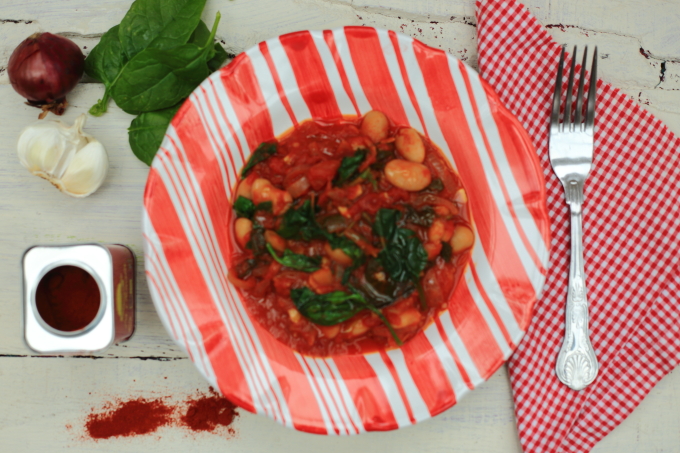
When it’s dark and cold, I like to eat food that reminds me of warmer sunnier times, like this Spanish butter bean stew that I ate in the Spanish mountains in October and have been cooking regularly ever since. It includes plenty of prebiotic fibre and you can have a piece of grilled salmon or tuna on the side for a boost of Vitamin D.
SPANISH BUTTER BEAN STEW
- 1 red onion, thinly sliced
- 1 red pepper, thinly sliced
- 2 tbsp olive oil
- 2 cloves garlic, sliced
- 2 cans tomatoes
- 2 cans butter beans
- 2 heaped tsps. (more if you like it stronger) smoked paprika
- 1 bag of spinach leaves
Saute the onion and red pepper in the olive oil for 5 minutes.
Add the garlic and the smoked paprika and stir briefly.
Add the tinned tomatoes and drained butterbeans. Let it simmer for 20 minutes.
Add the spinach and let it wilt in the tomato-beans mixture. This will take 3-4 minutes.
Check for seasoning and serve.
Y Viva Espagna!
Annabel
Love your blog. Like you not keen on taking supplements , vitamins.
Having been diagnosed with early osteopenia via a bone density scan following early onset menopsuse , about 42 yrs old when periods stopped, initially improved diet and started running to increase weight bearing exercise, no advised calcium,vit d supplements started. 3 years later follow up scan showed slight deterioration.
A friend recommendedca vit D blood test , which showed my extremely low levels, despite a fairly outdoor life style. Very keen gardener in West Sussex !
Following a prescribed intense course of Vit D, follow up blood test showed now at correct levels. I understand that Vit D required for correct uptake of calcium . I now take a daily all year Vit D supplement and look forward with interest to see how affects bone density scan.
Thanks for the comment, Louise. Do keep us posted on the bone density scan. Yes, I didn’t touch on calcium, but you are right that the two work together. Did you try a more comprehensive weight-bearing programme, in addition to running?
Thank you for your interesting and informative blogs. I love the way they are always supported by research and always look at both sides. I look forward to them and especially the recipes. Thank you. Lucy
Great post – good to see both sides of the argument. Am interested in lack of calcium with the rise in consumption of plant milk and eating less dairy, as well as teenager girls having enough iron. Keep the posts coming they are excellent!
Thanks Louise. Yes, Vit D and calcium go together like salt and pepper. Will have to cover that too. My daughters still eating red meat (just) but I suspect iron deficiencies will be the new Vit D ‘epidemic’. Interestingly Tim Spector stopped being a vegetarian after his research, deciding that the gut benefits from a little meat (although he was more concerned about B12 I recall).
Brilliant post ! Thank you for a sensible round up. Here in sunny Glasgow I started taking Vitamin D last winter after hearing figures on our chronic deficiency and a link to arthritis in hip and knee- anything to help with that ! I started turmeric too but with pipeline to aid absorption. It’s a nightmare trying to keep up with how much, sources, uptake rates etc. Last night I watched Trust me I’m a Dr on BBC (programme also came from Glasgow!) talking about iodine deficiency- worsening since we have dropped our milk drinking. Web sites urge you to eat seaweed, but they proved that the uptake from that source is less than half from white fish or milk.
Oops piperine not pipeline-
Thanks Jo. Yes, Professor Jones talked ALOT about Scotland… fascinating and worrying in equal measure. And yes, Vit D also linked to numerous other things from arthritis to poor sleep. I am currently trialling turmeric too so do keep us posted.
Thank you Kale and Cocoa. I think vitamin D is just what I need and also with my son at uni in Scotland I’ve bought him some Vitamin D too. A quick question – what is better – the liquid form or tablets?
Hi Philippa – the key thing is to choose D3. I take a daily D3 capsule. If he’s ok with swallowing, i’d go for a tablet or capsule. This year is really bad – there’s been less sun shine than normal (which is saying something!)
Another great post and as I have had an experience with this issue, I will leave a comment..
I was living in a sunny country, but because I was a coeliac my doctor (who is also a coeliac) suggested I have blood tests. One was for vitamin D. The evening my results came in, she phoned me at home quite worried. I was to go to the nearest night-pharmacist and buy a bottle of Vit D of 1000 IUs. I asked why, and was told that my immune system was compromised, that I was unable to fight off infections and diseases unless my Vit D levels improved. After taking high level Vitamin D for 3 months, my levels were closer to normal and now I take a lower dose.
I do not absorb vitamins and minerals from food as easily as other non-coeliacs and need to be aware of iron and magnesium levels as well. I am grateful for receiving supplements and sometimes when I have no energy, I find a vitamin B shot helps.
Of course it is difficult to tell whether the vitamin D is really effective, but I know that I feel more energetic after a vitamin B shot.